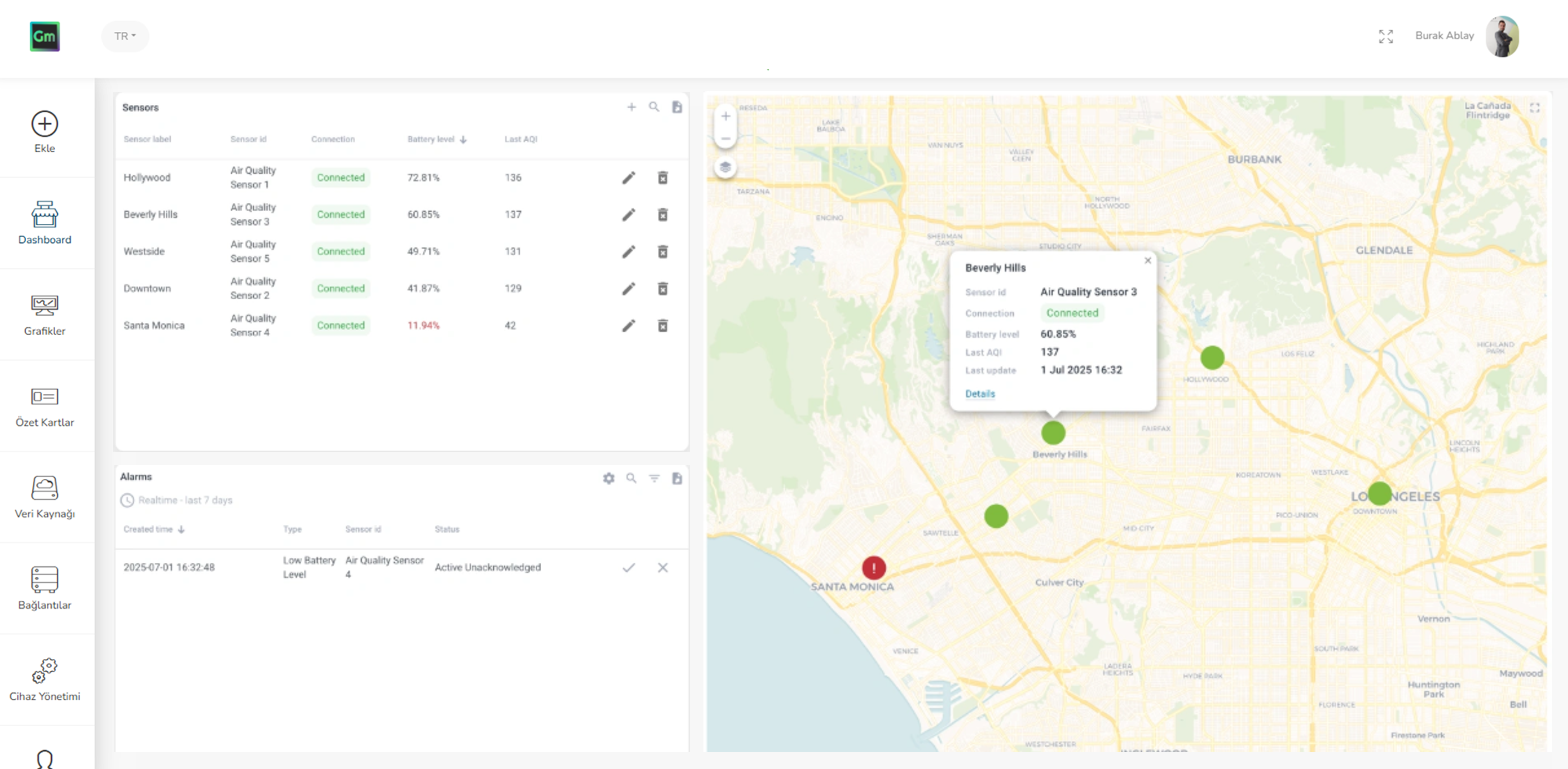
Cities, industrial zones, and high-traffic areas are constantly struggling with air pollution; a critical issue that affects both public health and regulatory compliance. From fine particulate matter (PM2.5, PM10) to harmful gases like SO₂ and CO, monitoring these environmental threats requires a robust and responsive system. OpenIoT tackles this challenge with unmatched flexibility and reliability.
Contact UsThe OpenIoT IoT platform is specially designed to address this challenge with its scalable architecture, multi-protocol support (MQTT, HTTP, CoAP, LwM2M), and powerful rule engine. It seamlessly connects distributed air quality sensors, ensures secure and reliable data ingestion, and enables real-time analytics and alerting in large-scale deployments.
With customizable dashboards, flexible data visualization tools, and low-code rule configurations, OpenIoT empowers organizations to deploy air quality monitoring systems faster, manage them efficiently, and respond proactively to environmental changes. Whether it's smart cities, industrial compliance, or public health initiatives, OpenIoT provides the performance and adaptability needed to take control of air quality.
Our team is a reliable partner for scalable solutions delivered on a fast and consistent timeline.

OpenIoT's air quality monitoring solution provides a scalable, real-time IoT-based platform for environmental intelligence. By combining pollution sensors with cloud dashboards, alarms, and data storage, it enables cities, industries, and institutions to act on air quality information. Its flexibility, open protocol support, and customizable visualization make it ideal for public health, regulatory compliance, and green initiatives.
Air quality monitoring systems continuously track pollution levels for cities, industrial facilities, and indoor areas to create healthy and safe environments. With the OpenIoT platform, particulate matter, gas concentrations, and environmental parameters can be centrally monitored, analyzed, and fast actions can be taken.
Air pollutants such as PM2.5, PM10, CO₂, NO₂, SO₂, and VOCs are measured in real-time. Risks that may occur at critical levels are detected early and preventive actions are taken.
Conditions that may affect human health are quickly determined through analysis based on the Air Quality Index (AQI). Risk management becomes easier, especially in densely populated areas.
Pollution density maps are created by visualizing data collected from different locations geographically. This allows for more accurate urban planning and environmental policy management.
Air quality data in indoor areas is integrated with building automation systems to automatically optimize ventilation systems. Comfort increases while energy consumption is balanced.
Causes of pollution increases can be determined with long-term data analysis. Sources such as industrial emissions, traffic density, or environmental factors are analyzed more clearly.
Compliance with environmental legislation becomes easier through automated data logs and reporting tools. Inspection processes are accelerated and corporate sustainability goals are supported.
An IoT-based solution like the air quality monitoring system powered by OpenIoT is adaptable in sectors where air quality impacts health, safety, or regulatory compliance. Its flexibility and real-time analytics make it valuable far beyond basic environmental use cases. Here are some key application areas:
OpenIoT helps protect public health by allowing city officials to build scalable sensor networks and automate air quality alerts.
Manufacturers use OpenIoT to monitor emissions and minimize environmental risks through customizable dashboards.
Build the data infrastructure that makes logistics networks more transparent and sustainable through driver safety and emission tracking.
Academic institutions can integrate OpenIoT's real-time data into curricula and citizen science initiatives.
Developers showcase air quality metrics for eco-friendly projects through public-facing dashboards.