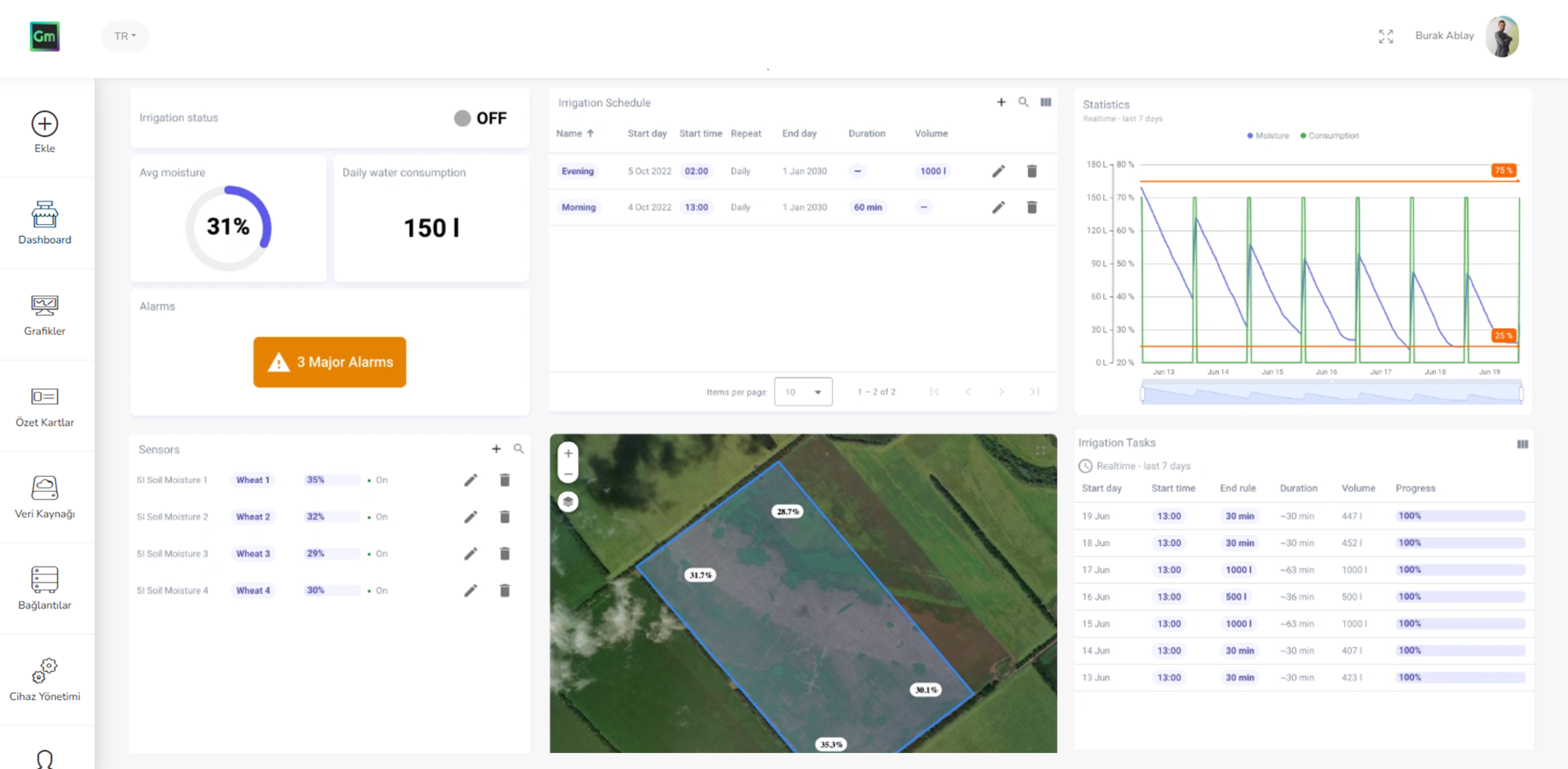
Global water scarcity, rising agricultural costs, and the need for sustainable farming have made smart irrigation not just a trend but a necessity. Traditional irrigation systems often lack responsiveness, leading to water wastage and crop stress. Modern agriculture requires a platform that can provide automation, precision, and adaptability; OpenIoT offers exactly that.
Contact UsThe OpenIoT IoT Platform is specifically designed to meet these needs with its robust architecture; it supports seamless integration of various sensors, reliable data collection via MQTT, CoAP, or HTTP, and powerful real-time analytics. By enabling farmers to monitor soil conditions, receive threshold-based alarms, and automate irrigation through intuitive rule chains, OpenIoT guarantees optimum water distribution and timely response to changing field conditions.
From small farms to enterprise-scale agribusinesses, OpenIoT scales effortlessly thanks to its edge computing capabilities, multi-tenant model, and rich dashboard customization. It enables agribusinesses to implement smart irrigation systems that not only save water and increase yield but also reduce manual labor, increase traceability, and align with long-term sustainability goals.
Our team is a reliable partner for scalable solutions delivered on a fast and consistent timeline.

The smart irrigation solution built on OpenIoT allows users to intelligently manage irrigation processes, reduce water waste, and precisely protect plant health. Leveraging real-time data collection, powerful automation, and rich visualizations, it enables scalable applications across various sectors from agriculture to urban landscapes. Thanks to its flexible architecture and low-code configuration capability, the solution can be rapidly deployed, customized, and expanded as needs grow.
Smart irrigation systems optimize water use by providing data-driven decision mechanisms for agricultural production areas, landscaped areas, and urban green space management. Thanks to the OpenIoT platform, irrigation infrastructures can be monitored centrally, controlled automatically, and resource efficiency can be increased sustainably.
By analyzing soil moisture sensors, weather data, and plant needs, the amount of irrigation is adjusted automatically. In this way, excessive or insufficient irrigation is prevented and crop health is protected.
Water and energy consumption are continuously monitored to prevent unnecessary use. Thanks to smart planning, operating costs decrease while more efficient use of resources is ensured.
Different irrigation zones can be managed through a single platform. Users can remotely access systems via mobile or web interfaces and perform instant interventions.
Manual workload is reduced thanks to automatic scheduling and smart scenarios. Irrigation processes are carried out more regularly, quickly, and flawlessly.
Using the right amount of water contributes to the protection of soil structure and reduces environmental impacts. Sustainable management of water resources is supported.
Collected data is reported to analyze irrigation performance. Thanks to long-term data, more accurate planning is made and strategic decisions are supported.
Thanks to the real-time data, automation, and scalability provided by the OpenIoT IoT platform, this solution can be effectively used across multiple sectors by meeting specific operational needs:
Meets the need for data-driven water management by providing real-time moisture analysis, an alarm system, and automated irrigation, thereby reducing resource waste while increasing crop efficiency.
Meets the need for microclimate-based irrigation with multi-zone sensor management and conditional scheduling support, ensuring healthy plant growth with minimum manual intervention.
Offering a centralized control panel, alarm notifications, and device management for public green spaces, solving the wide-area water efficiency problem.
Ensures optimum soil conditions with zone-specific moisture monitoring, historical analysis, and rule-based irrigation triggers, maintaining turf quality uniformity.
Providing high-resolution telemetry tracking, custom rule chains, and rapid integration of new devices, meeting the need for accurate environmental data collection and testing flexibility.