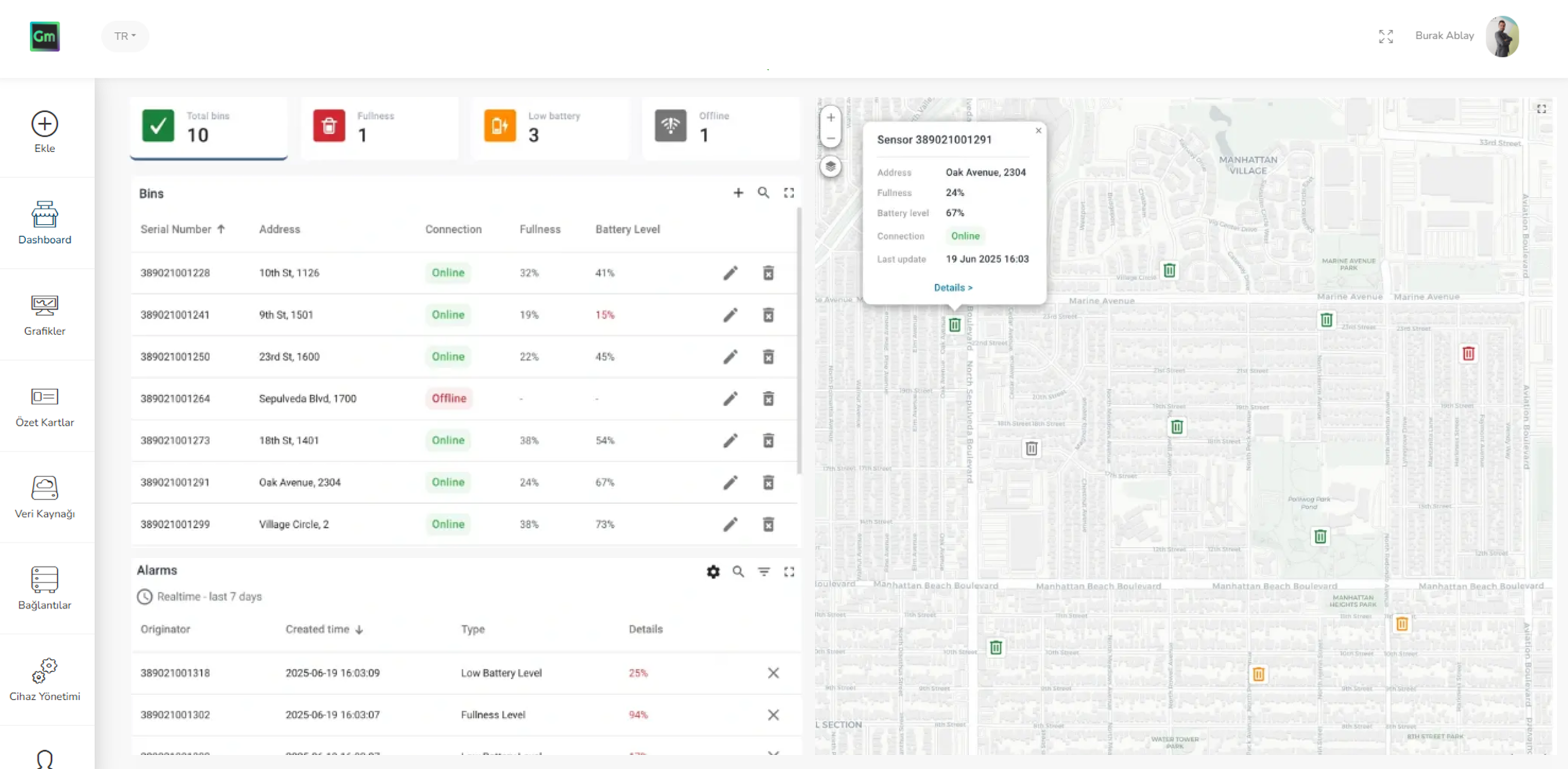
As urban populations grow and sustainability standards tighten, waste management systems must evolve to be more efficient, scalable, and data-driven. Traditional methods based on fixed collection schedules and manual checks often lead to overflows, wasted resources, and high operating costs. The OpenIoT Platform addresses these challenges effectively by offering powerful tools for real-time monitoring, automation, and optimization of waste operations.
Contact UsThe OpenIoT platform transforms waste collection logistics for cities, campuses, and businesses by providing real-time monitoring via sensor-equipped waste bins. As these sensors transmit live data on fill levels, battery status, and connectivity, OpenIoT processes telemetry instantly, allowing operators to reduce unnecessary collections, lower emissions, and respond proactively to service needs. With flexible device integration, rule-based automation, and customizable dashboards, OpenIoT enables waste management teams to deploy quickly, scale easily, and make smarter decisions based on actionable insights.
Supporting industry-standard protocols like MQTT, CoAP, and HTTP, OpenIoT ensures seamless sensor connectivity at scale. The Rule Engine allows for complex event processing and alerting, while its dedicated architecture supports parallel use by multiple stakeholders, from municipal departments to private contractors. Combined with powerful analytics and visualization tools, OpenIoT provides a complete and future-ready solution for smart waste management.
Our team is a reliable partner for scalable solutions delivered on a fast and consistent timeline.

OpenIoT's waste management solution addresses a critical urban and industrial challenge with precision, scalability, and real-time intelligence. From seamless sensor integration to customizable dashboards and a proactive alert system, it empowers stakeholders to manage waste efficiently and sustainably. Based on IoT, this solution forms the foundation for smarter, cleaner cities and optimized resource management.
Smart waste management systems provide more efficient and sustainable waste management by monitoring container fill levels, collection operations, and logistics processes in real-time. With the OpenIoT platform, all waste collection infrastructure can be centrally monitored, analyzed, and optimized.
Waste containers are monitored via sensors to track fill levels in real-time. Unnecessary collection operations are prevented, and resource utilization is optimized.
Through data-driven route planning, collection vehicles are directed to the most efficient routes. Fuel consumption decreases, operation times are shortened, and service quality increases.
All containers, vehicles, and field operations are managed through a single platform. Authorities can monitor operation status instantly to take quick action.
Overflow, odor, or improper use situations are detected early to reduce environmental risks. Urban cleanliness and quality of life are improved.
Maintenance plans are created by analyzing the usage data of containers and equipment. The life of physical assets is extended, and fault costs are reduced.
Recycling rates, operational performance, and costs are analyzed in detail through the collected data. Institutions can manage sustainability goals more effectively.
Built on the OpenIoT platform, this solution is highly adaptable, meeting the operational needs of many sectors by offering real-time monitoring, flexible device integration, smart alerting, and powerful analytics. Here are five key sectors where it provides value:
Enables city authorities to optimize waste collection routes and respond faster to bin overflow alarms using OpenIoT's real-time telemetry, automated rules, and geolocation-based dashboards.
Ensures safe and compliant waste handling in manufacturing areas through detailed sensor data, custom alarms, and support for legacy device integration.
Supports sustainability goals with smart bin tracking, usage analysis, and seamless deployment across distributed locations, all managed from a central dashboard.
Maintains hygiene and safety in high-traffic areas by providing dynamic monitoring and maintenance scheduling through OpenIoT's event-driven automation.
Manages fluctuating waste loads during events through scalable sensor connectivity and predictive analytics, ensuring clean environments and resource efficiency.