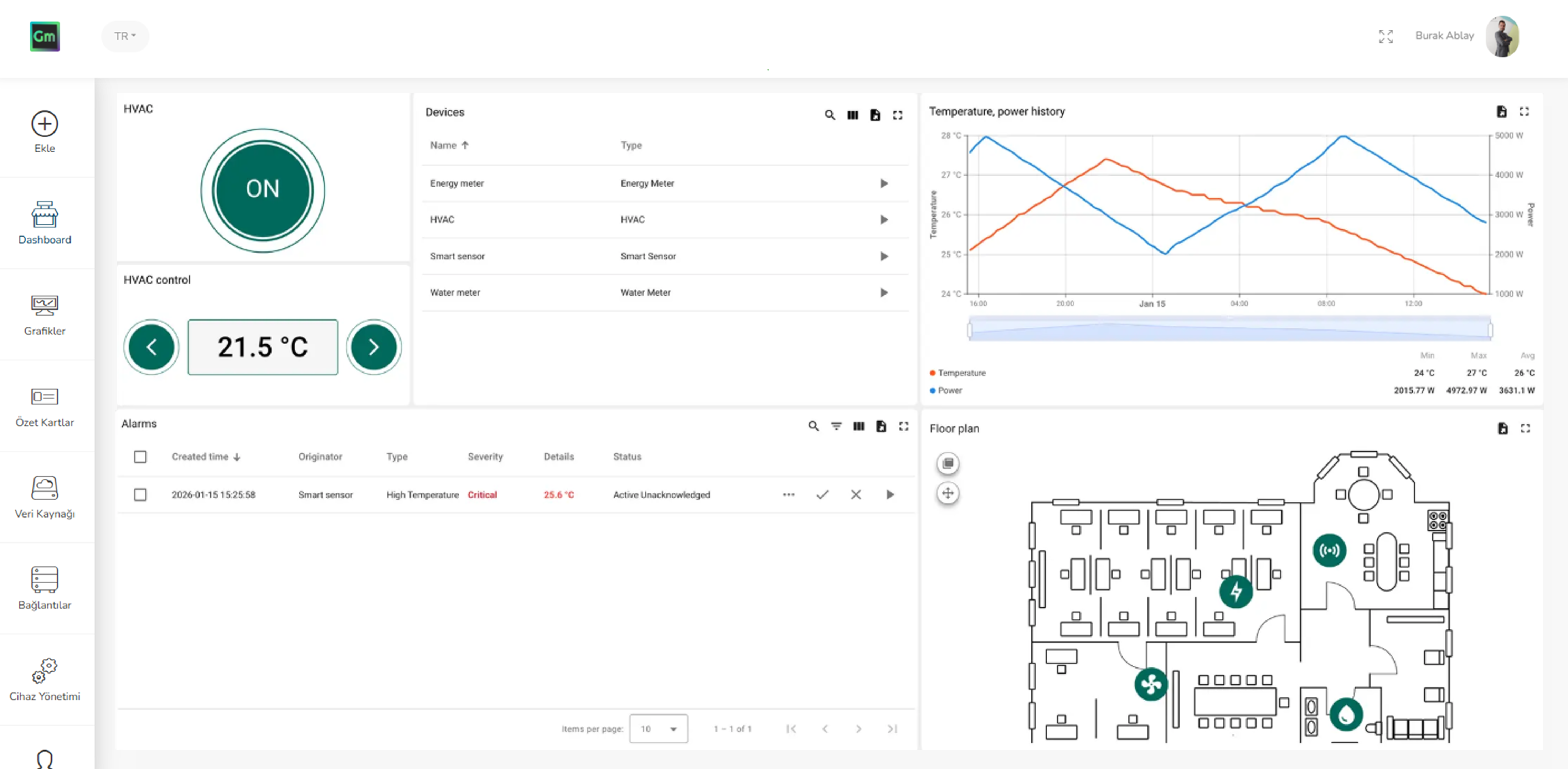
The smart office solution powered by OpenIoT enables efficient monitoring of energy and water consumption, tracking of air quality and CO2 levels, control of HVAC systems, real-time response to critical events, and general improvement of energy efficiency and employee comfort.
Contact UsSmart office solutions are designed to optimize workplace environments by monitoring key operational parameters and automating building systems in real-time. OpenIoT, a robust IoT platform, provides all the necessary tools for data collection, processing, and visualization from devices using protocols such as BLE or LoRaWAN gateways, offering support for seamless integration and flexible solutions.
Thanks to OpenIoT technology, integrating and visualizing data from various devices and sensors becomes easy, allowing for the creation of smart, data-driven solutions. This approach enables active management in addition to real-time monitoring of office conditions; allowing systems to be turned on and off, alerts to be received, and automation scenarios to be configured. All these features are fully showcased in our smart office solution.
Our team is a reliable partner for scalable solutions delivered on a fast and consistent timeline.
The smart office project demonstrates how IoT and OpenIoT integration can significantly improve office building management. This is not just a dashboard; it's a powerful tool to increase efficiency, security, and comfort. The solution can be easily scaled, integrated, and customized to fit every business's needs. With OpenIoT, you don't just monitor your office, you take control.
Smart office systems provide more efficient, comfortable, and sustainable work environments by monitoring workspaces, energy consumption, ambient conditions, and office equipment. With the OpenIoT platform, office infrastructures can be centrally managed, analyzed, and optimized.
Area management is optimized by monitoring usage rates of meeting rooms, common areas, and work zones. Office resources are used more efficiently.
Lighting, HVAC, and energy consumption are automatically controlled based on sensor data. Both employee comfort increases and energy costs decrease.
Office systems can be monitored and managed through a single platform. Operational processes become easier and the need for manual intervention decreases thanks to automated scenarios.
A secure working environment is provided by monitoring entry-exit movements, security systems, and critical areas. Unauthorized access risks are reduced.
Processes are improved by analyzing usage status and performance of office equipment. Workforce and resource planning are done more effectively.
Energy consumption, area usage, and operational performance are reported thanks to detailed data. Institutions reach sustainability goals more easily.
The smart office approach can easily be adapted to various other sectors.
Energy consumption monitoring, HVAC automation in shopping areas, and lighting control.
Energy audits, airflow monitoring, and smart overload notifications.
Microclimate control in patient rooms, monitoring occupancy rates, and tracking CO2 levels and temperature.
Room automation, personalized climate control, and monitoring of CO2 levels and area occupancy rates.
Managing comfort and resource usage in educational institutions.