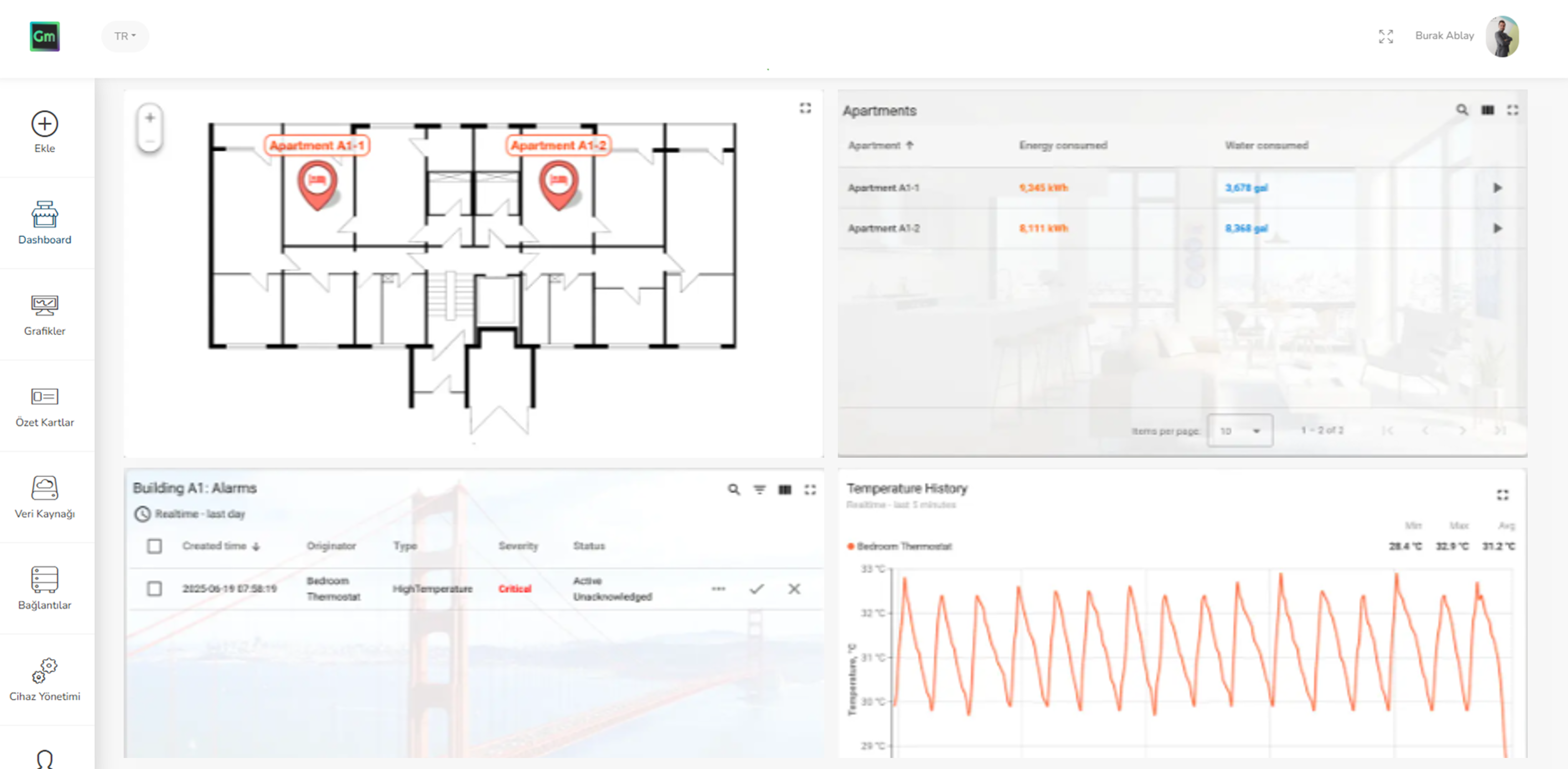
In today's rapidly growing urbanized infrastructure, energy efficiency and water management have become the most important priorities. Smart metering solutions powered by the OpenIoT IoT platform offer a transformative approach to monitoring water and energy consumption by providing stakeholders with accurate and real-time information on consumption patterns.
Contact UsWith enhanced visibility, municipalities, facility managers, and utility providers can make faster, data-driven decisions that optimize resource usage, reduce waste, and lower operating costs.
OpenIoT plays a key role in this universe by providing flexible, open-source tools to collect, process, and visualize telemetry data across distributed assets such as meters, sensors, and edge devices. Its modular architecture and rich feature set ensure seamless integration of various devices, guaranteeing reliable real-time monitoring and control of utility infrastructure.
This use case demonstrates how OpenIoT enables organizations to build robust, end-to-end smart metering solutions. By combining protocol flexibility, intuitive dashboards, and powerful rule engines, OpenIoT facilitates monitoring energy and water usage in residential, commercial, and municipal environments, enhancing sustainability and operational control.
Our team is a reliable partner for scalable solutions delivered on a fast and consistent timeline.

IoT smart metering with OpenIoT offers a scalable and flexible way to monitor energy consumption. Through sensor integration and protocol support, data is collected and visualized across regions, buildings, and apartments. OpenIoT enables monitoring energy usage, alarms, and temperature trends, helping users make timely decisions and reach sustainability goals across industries. With OpenIoT, organizations can build future-ready smart metering systems that create scalable, adaptable, and sustainable impact.
IoT-based monitoring and management solutions, such as IoT smart metering systems, can be adapted and applied to various industries and fields. Here are some of them:
Optimize water and energy management city-wide to support sustainable urban development.
Ensure operational efficiency and compliance with green building standards by monitoring real-time resource usage.
Empower facility managers to improve campus energy efficiency and promote eco-friendly behavior.
Enable homeowners and tenants to monitor and reduce their energy bills through transparent usage tracking.
Gain insights into high consumption areas, detect leaks or excessive use early, and prevent costly downtime.