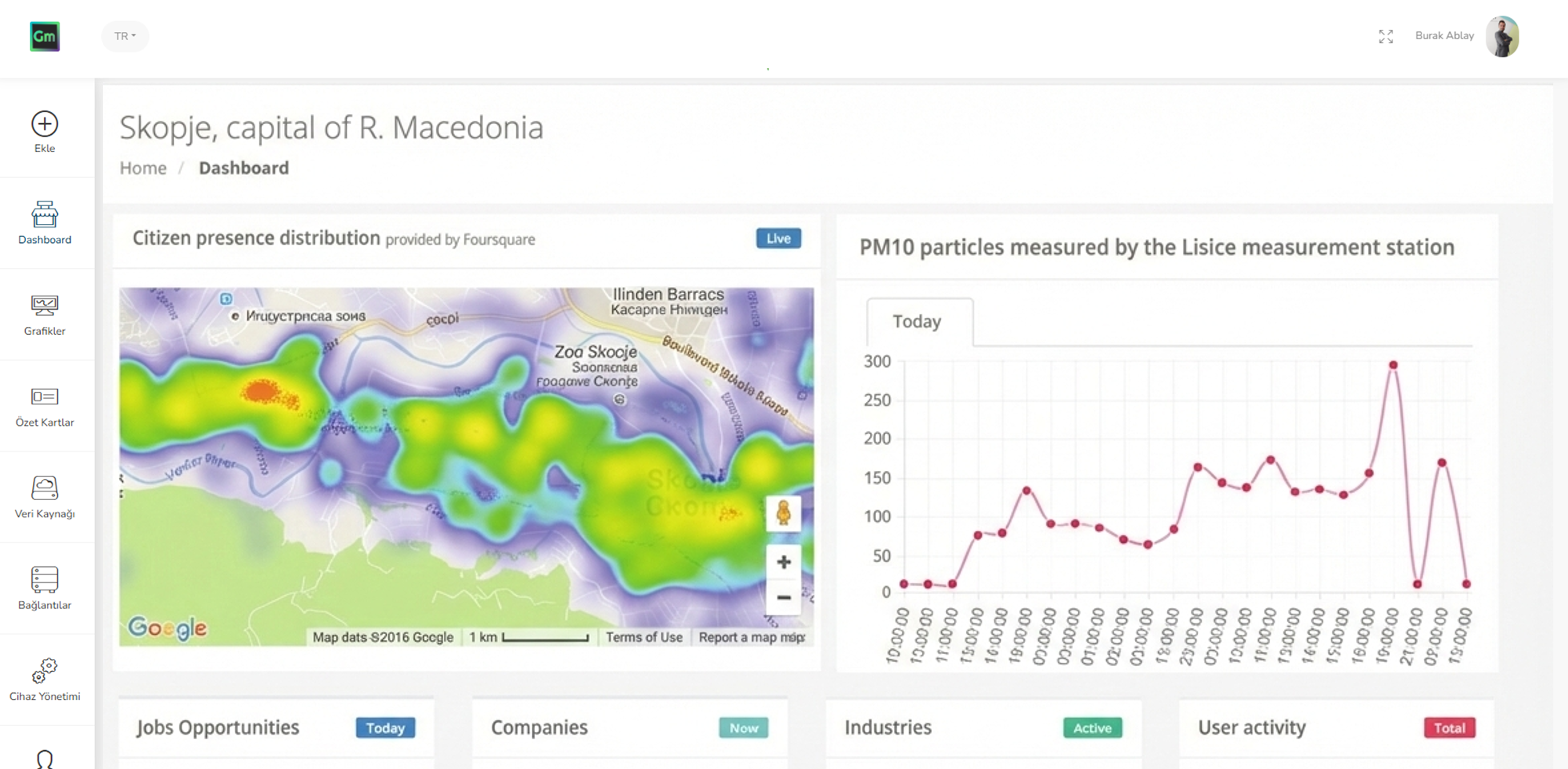
Smart city systems are digital solutions that enable centralized monitoring, analysis, and management of urban infrastructure and services. The OpenIoT platform combines data from city components to provide more efficient, secure, and sustainable city management opportunities.
Contact UsIn smart city systems, the ability to collect, analyze, and visualize data from different infrastructures allows city managers to make more informed decisions and respond quickly to changing conditions. The OpenIoT platform provides a centralized monitoring and management infrastructure by collecting data from various sources such as transportation systems, energy infrastructures, environmental sensors, water management, and public services. In this way, city operations can be managed holistically through a single platform.
With OpenIoT, system performance across the city can be monitored in real-time, resource use can be optimized, density and demand trends can be analyzed, and abnormal situations can be intervened immediately. This approach forms a strong foundation for digital transformation projects that increase the quality of life for citizens by ensuring that smart cities are managed more sustainably, safely, and efficiently.
Our team is a reliable partner for scalable solutions delivered on a fast and consistent timeline.

Smart city solutions provide a wide range of advantages for municipalities, infrastructure operators, and city managers, enabling more efficient, secure, and sustainable city management. With the OpenIoT platform, city components can be centrally monitored, analyzed, and optimized.
Through real-time monitoring, malfunctions and abnormalities that may occur in city infrastructures are detected early. This approach reduces downtime, increases response speed, and minimizes operational risks.
Through IoT-based analysis tools, the consumption of energy, water, and other resources is monitored to increase usage efficiency. Demand trends are analyzed to prevent unnecessary consumption and lower costs.
Different city systems can be monitored and managed through a single platform. Centralized control of transportation, lighting, environmental sensors, and infrastructure systems simplifies management and accelerates decision-making processes.
The performance of city services is improved by analyzing collected data. Thanks to process optimization, both operational efficiency and citizen satisfaction increase.
Continuous monitoring and smart automation mechanisms reduce operating costs while making it easier to reach sustainable city goals. Proper management of resources provides long-term economic advantages.
Automated reporting and monitoring infrastructure ease compliance with environmental and operational regulations. Audit processes accelerate and data accuracy increases.
With OpenIoT, smart city solutions offer an end-to-end integrated IoT management infrastructure for urban operations. By combining different city components, from transportation to energy, and environmental monitoring systems to infrastructure management onto a single platform, it provides real-time data monitoring, analysis, automation, and control. Thanks to user-friendly panels and centralized management tools, city managers can increase operational efficiency, optimize resource use, improve service quality, and gain full visibility across the city.
The OpenIoT Smart City platform provides a flexible and scalable infrastructure that enables centralized monitoring and management of different urban systems. Efficiency of city operations is increased and sustainable management is provided through real-time data collection, analysis, and automation capabilities:
Urban transportation is made more efficient and safe through traffic density monitoring, smart signalization management, public transport tracking, and mobility analysis.
Energy efficiency is increased, maintenance processes are optimized, and costs are reduced by monitoring street lights, energy consumption points, and distribution infrastructures.
City life quality is increased and environmental risks are detected early by monitoring air quality, noise level, temperature, humidity, and other environmental parameters.
Malfunctions are quickly detected, resource losses are reduced, and operation continuity is ensured by monitoring water distribution networks, pressure systems, wastewater lines, and infrastructure equipment.
City security and operational continuity are supported through monitoring critical facilities, alarm management, tracking field equipment, and event management.