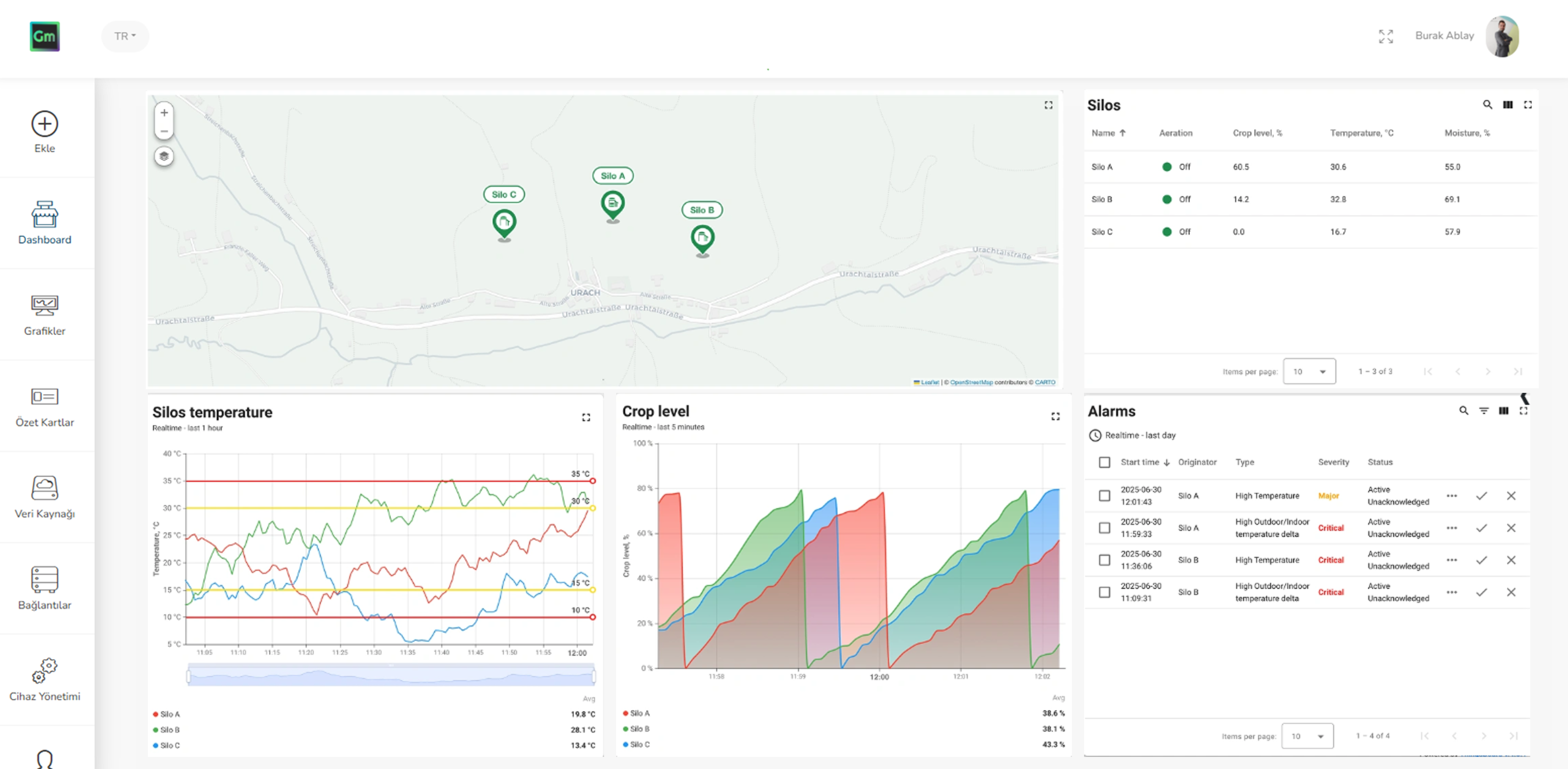
Modern agriculture is undergoing a digital transformation driven by the need for sustainability, efficiency, and resilience. Farmers and agribusinesses face increasing pressure to optimize yields, reduce resource consumption, and mitigate climate and storage-related risks. OpenIoT simplifies this task by providing real-time data collection, automation, and intuitive visualization tailored to smart farming needs.
Contact UsThe OpenIoT IoT platform offers agricultural stakeholders a powerful and scalable solution for collecting, processing, and visualizing environmental and operational data. Its support for multiple communication protocols and seamless device integration makes it ideal for various agricultural environments, such as remote fields, greenhouses, or storage facilities.
By using OpenIoT, agribusinesses gain full control over their assets and infrastructure, from temperature and humidity sensors to automated ventilation systems. With real-time dashboards, rule-based alerts, and remote control features, the platform helps reduce waste, improve product quality, and lower operating costs.
Our team is a reliable partner for scalable solutions delivered on a fast and consistent timeline.

With OpenIoT, smart farming offers a complete end-to-end IoT solution for agricultural operations. From field to storage, it combines device connectivity, real-time analytics, control systems, and user-friendly dashboards. By adopting this solution, agribusinesses can increase efficiency, ensure compliance, minimize losses, and achieve full transparency across their entire value chains.
Smart farming solutions provide a wide range of advantages for agribusinesses, producers, and field managers, enabling more efficient, sustainable, and controlled production. With the OpenIoT platform, agricultural operations can be centrally monitored, analyzed, and optimized.
Through real-time monitoring, risks in field conditions, equipment status, and environmental factors are detected early. This approach reduces product losses, increases response speed, and minimizes operational risks.
Efficiency in the use of water, fertilizers, and energy resources is increased by monitoring through IoT-based analysis tools. Automatic control mechanisms based on need prevent unnecessary consumption and lower costs.
Different agricultural fields, greenhouse systems, and equipment can be monitored and managed through a single platform. This centralized structure makes it easier to plan and manage operations.
Production processes are optimized by analyzing collected data. Thanks to accurate timing and precise control, both efficiency and product quality improve.
Smart automation and continuous monitoring reduce operating costs while making it easier to reach sustainable agriculture goals. Proper use of resources provides long-term economic advantages.
Automated reporting and monitoring infrastructure ease compliance with agricultural production standards and quality requirements. Audit processes accelerate thanks to traceability.
The Smart Farming solution built on the OpenIoT platform is highly adaptable, meeting the specific needs of various sectors of agriculture and agricultural technology. Its powerful features such as real-time telemetry, rule-based automation, multi-protocol support, customizable dashboards, and scalable architecture make it ideal for a wide range of applications:
Enables remote monitoring of storage silos, automated alarm systems, and minimum maintenance requirements.
Integrated with GPS and routing systems, it tracks soil moisture and growth conditions in vineyards and orchards.
Tracks water or fertilizer tank levels in greenhouses with location-based analysis and consumption prediction.
Inspects cold storage and logistics processes for compliance and safety in industrial agricultural environments.
Manages drinking water or feed silos for livestock with centralized monitoring and regulatory reporting.