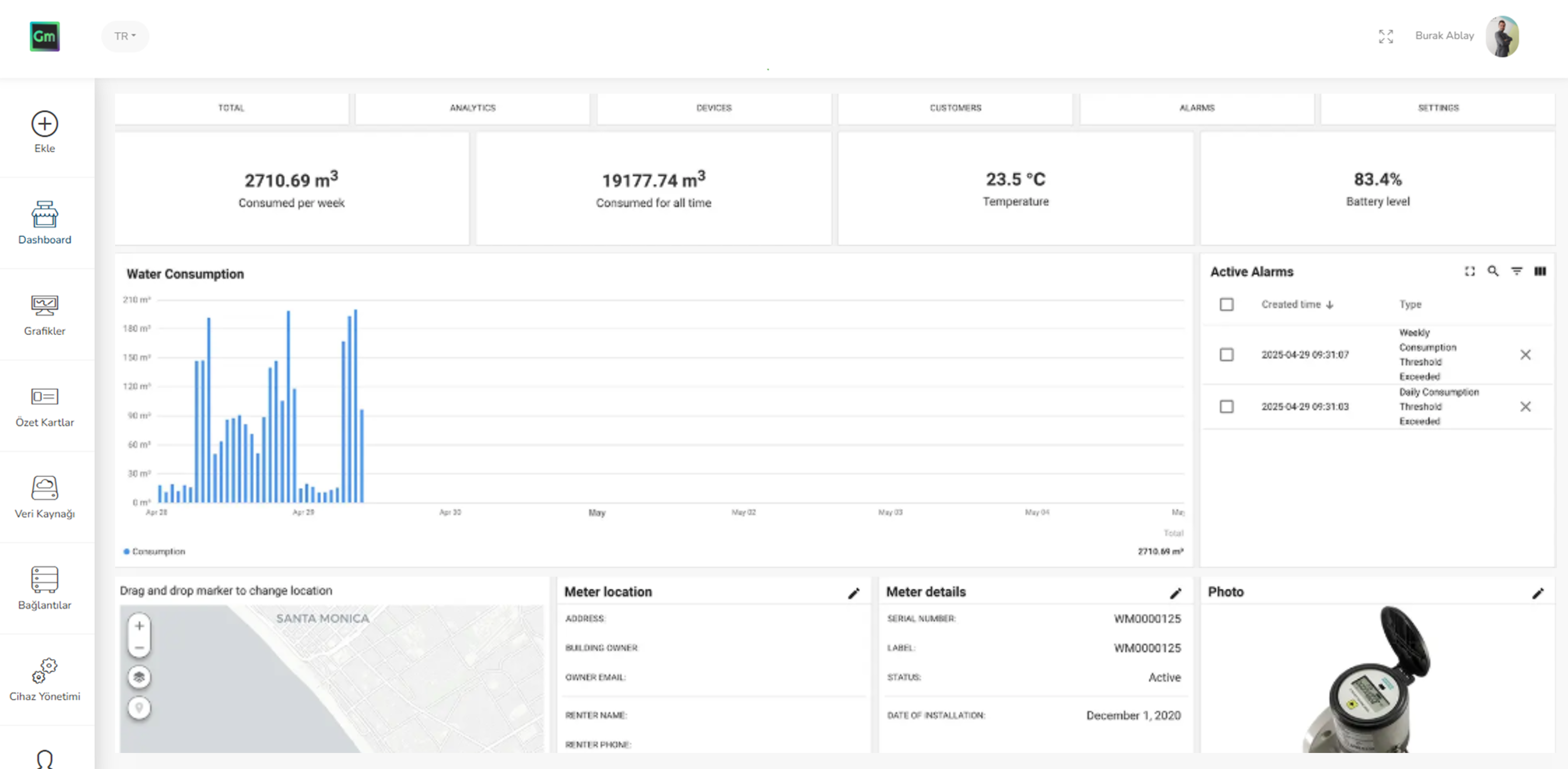
Water is one of our most critical resources, and managing its distribution and consumption is essential for sustainable urban development, utility cost control, and infrastructure maintenance. For this purpose, the OpenIoT platform, which offers powerful capabilities for real-time monitoring, alerts, visualization, and analysis, is an ideal choice.
Contact UsTraditional water metering methods often fall short in providing real-time data, accurate billing, and predictive maintenance information. By leveraging connected sensors and smart dashboards, organizations can gain powerful insights into water usage, detect anomalies like leaks, and automate alarm systems. At the heart of these solutions is OpenIoT, a flexible IoT platform that enables real-time collection, processing, and visualization of telemetry data from water meters.
This OpenIoT-powered water metering solution provides complete real-time visibility into water usage, immediate response to anomalies, and valuable analytics for long-term infrastructure planning. Scalable across municipalities, residential complexes, and commercial facilities, this solution offers a powerful tool for smart and efficient water resource management.
Our team is a reliable partner for scalable solutions delivered on a fast and consistent timeline.

With its low-code approach, intuitive dashboards, and comprehensive alert mechanisms, OpenIoT is one of the cornerstones of digital transformation in water resource management. Whether you're scaling for a city or optimizing a single facility, this solution adapts to your needs step by step.
Smart water metering systems provide more efficient and sustainable water management by monitoring water consumption, flow data, and network status in real-time. With the OpenIoT platform, all meter data can be collected centrally, analyzed, and operation processes can be optimized.
Water usage data is tracked instantly and consumption trends are analyzed. Unexpected increases and potential leaks are detected quickly.
Water losses and leakage situations are identified at an early stage by analyzing flow data. Response times are shortened and resource losses are reduced.
Meters in different locations can be monitored via a single platform. Remote reading reduces the need for manual operations and increases operational efficiency.
Billing processes are improved with accurate and reliable measurement data. User-based consumption analysis can be performed.
Network performance is evaluated by analyzing pressure, flow, and usage data. Malfunctions and maintenance needs are pre-determined.
Water consumption becomes manageable thanks to detailed reports. Institutions reach their sustainable resource management goals more easily.
IoT-based water metering systems are not just limited to utility companies. The same architecture and approach can be reused across a wide variety of industries:
Municipalities can automate meter reading and billing processes using IoT-based water metering systems, gain insights into city-wide consumption trends, and respond immediately to issues such as leaks or excessive use.
Water metering in smart buildings allows facility managers to fine-tune plumbing infrastructure, minimize waste through real-time monitoring, and improve the overall experience and sustainability for residents.
Farmers can leverage real-time data to optimize irrigation schedules, reduce unnecessary water use, and improve crop yields while protecting their environmental responsibilities.
Industrial organizations use accurate water monitoring systems to comply with strict environmental standards and manage energy costs more effectively through estimated consumption data.
Hotels and resorts can monitor water use across different zones or guest areas to implement sustainable practices, reduce operating costs, and involve guests in environmentally conscious initiatives.