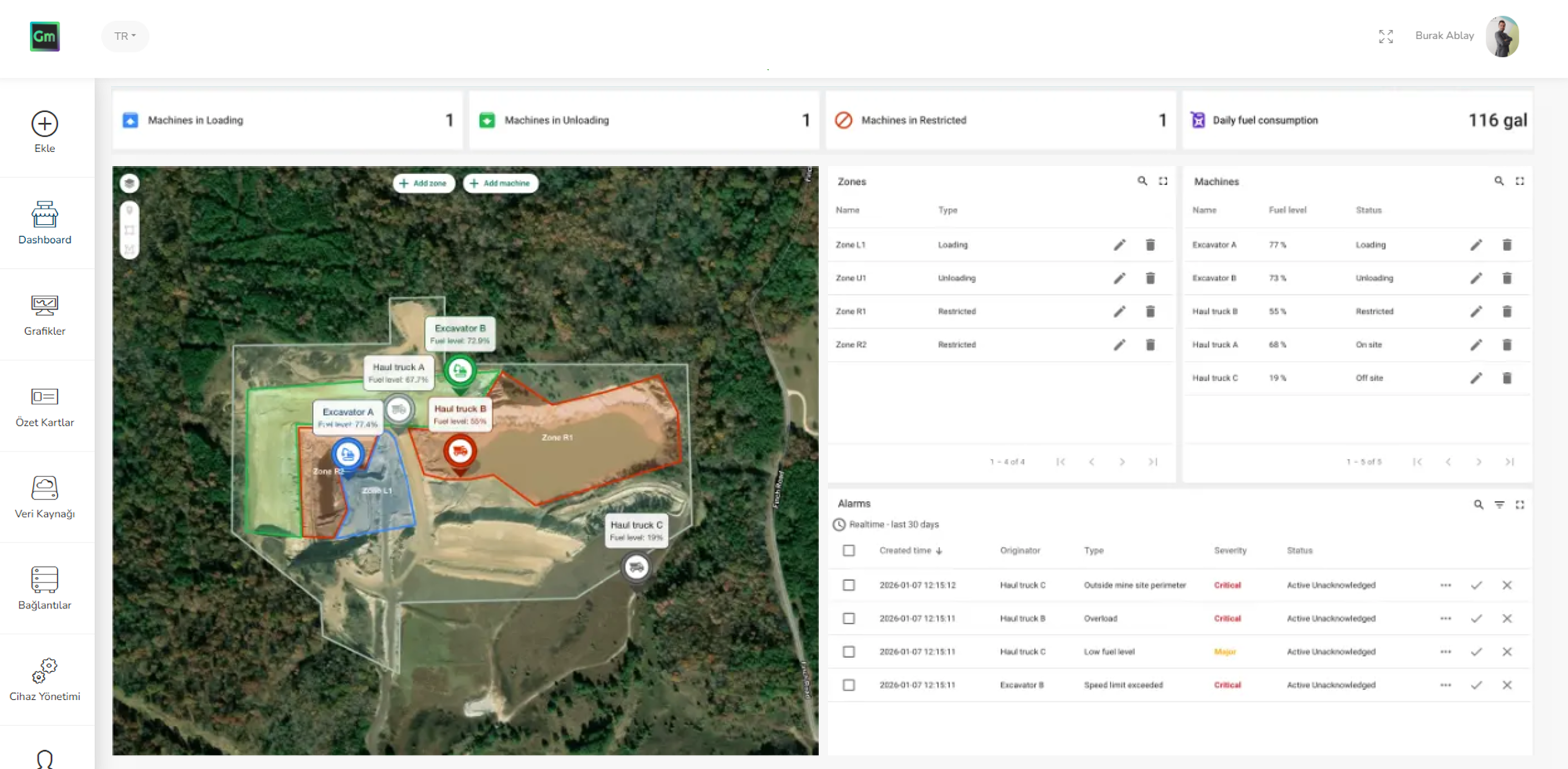
In field operations where heavy equipment and vehicle fleets are managed, simple location tracking is not enough. Real-time visibility, safety control, and operational efficiency must be addressed together. The OpenIoT platform analyzes data from vehicles and equipment to answer not just "where?" but also "how efficiently?" and "how to optimize?".
OpenIoT offers a scalable and real-time infrastructure for complex field operations. Through geographic control (geofencing), telemetry analysis, and intelligent alarm mechanisms, it transforms the way equipment and vehicles are monitored — all without the need for complex configurations.
Zero-code automation is achieved with calculated fields, geofencing logic, and dynamic alarm rules. This makes operations more predictable, safer, and more efficient.
Our team is a reliable partner for scalable solutions delivered on a fast and consistent timeline.

The OpenIoT Platform sets a new standard for a no-code industrial IoT approach. Without the need for complex rule chains, it reduces the configuration burden through calculated fields and dynamic alarm rules, accelerating the deployment process and enabling teams to make safer and more informed decisions.
The platform brings together all the components necessary for real-time monitoring, performance analysis, geofencing control, and automated alerts into a powerful and flexible dashboard layer.
It can be applied in various scenarios from heavy equipment sites to logistics operations, offering high operational visibility, predictability, and scalability.
Site fleet tracking systems increase operational efficiency by monitoring the location, usage status, and performance of vehicles, equipment, and field operations in real-time. With the OpenIoT platform, all fleet assets can be centrally managed, analyzed, and processes can be optimized.
Vehicles and equipment are instantly tracked for location, speed, operating status, and usage information. Operational visibility increases and control becomes easier.
Fleet usage data is analyzed to optimize route planning, task distribution, and resource utilization. Unnecessary waiting times and fuel consumption are reduced.
All vehicles, field equipment, and mobile assets are managed through a single platform. Authorities can access real-time status information to make quick decisions.
By monitoring operating hours and performance data, maintenance needs are predetermined. Unplanned breakdowns are reduced and equipment life is extended.
Alerts are generated upon detecting unauthorized use, speed violations, or unusual movements. Personnel and equipment safety is enhanced.
Fuel, maintenance, and operational costs are analyzed through detailed usage reports. Budget management is improved with data-driven decisions.
Such a solution is perfectly suited for various industrial and logistics use cases where area-based automation, fleet safety, and machine telemetry are crucial:
Track machines in loading, hauling, and restricted zones using automated alerts and fuel analysis.
Send automatic notifications when haul trucks or loaders enter, exit, or overstay in processing areas.
Monitor heavy machinery in temporary or moving zones, ensuring compliance with route rules and operational safety.
Better track fleet movements in bridges, tunnels, or time-critical zones during large-scale construction projects.
Use geofencing to protect environmental boundaries and track equipment in remote forested areas.